At Unbound, we use clinical research grade Force Plates — the same technology used by the Premier League, NFL, Olympic athletes and Formula 1 drivers — to map your physical “chassis” with millisecond precision.
Your Force Plate results tell you your physical function now, where to spend your effort to get the most out of your training, and track meaningful progress over time. With Force Plates, you can see how every step, every class, every competition counts — no matter the number on the bathroom scales.
What exactly are Force Plates?
At first glance, a force plate looks like a high-tech bathroom scale. However, while a smart scale measures your total weight and estimates (poorly) your muscle and body fat %, a force plate measures Ground Reaction Force (GRF).
When you stand, jump, or balance on the plates, sensors capture the force you exert on the ground up to 1,000 times per second. This data reveals “invisible” metrics that the human eye, wearables, and even standard gym equipment simply cannot see.
How Force Plates Work: The Science of “Invisible” Data
Force plates provide three critical categories of data that define your physical healthspan:
1. Left/Right Symmetry
We all have a dominant side, but even small imbalances — from around 10% upwards — can put you at significant risk of injury. They will also hold you back by reducing your jumping, sprinting, and change of direction performance(2).
Force plates reveal if one leg is doing more work than the other in the movements during a normal day as well as specific exercises like jumps, squats, or deadlifts.
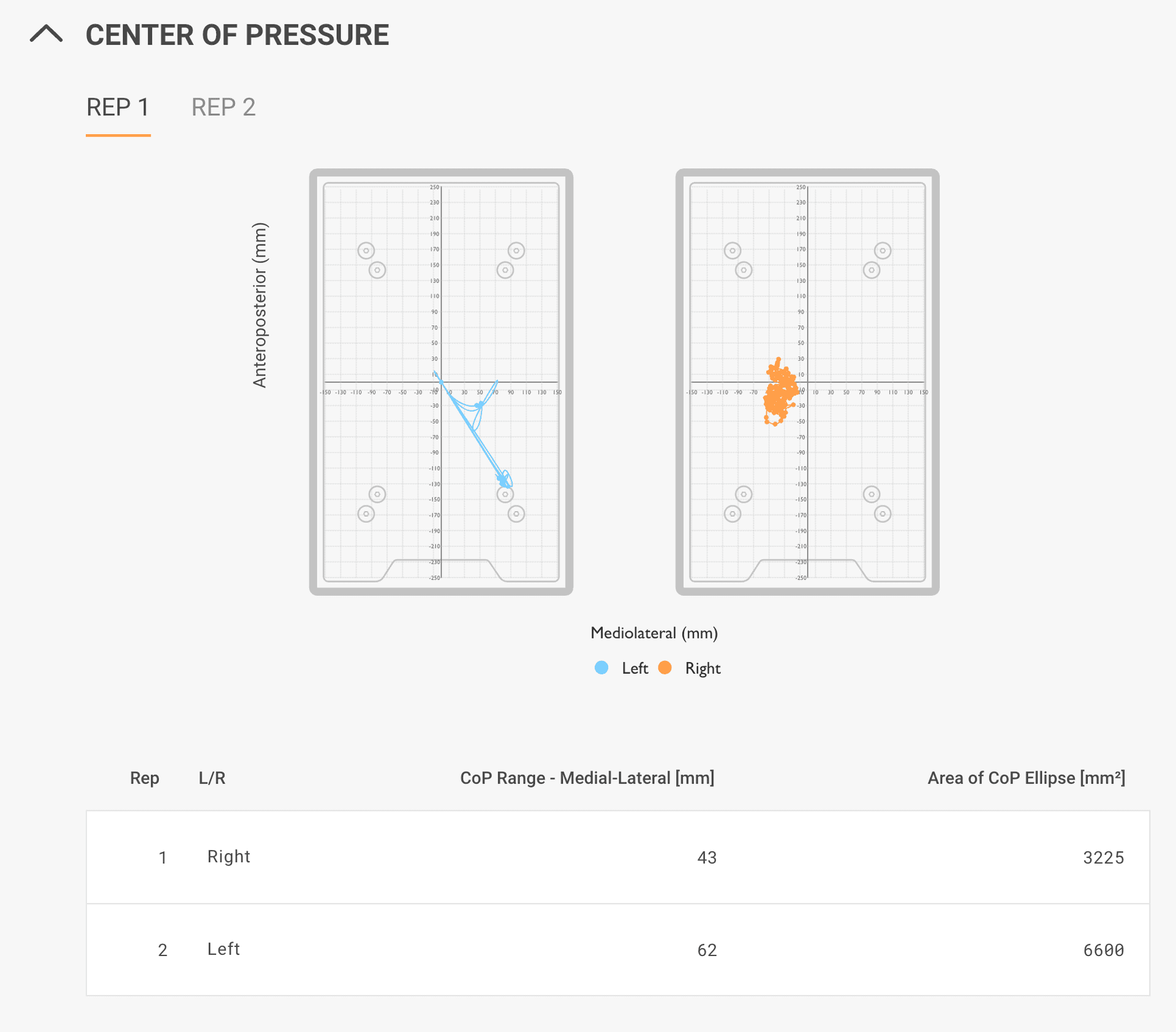
Check out the picture below which shows a stable right leg and wobbly left during a single-leg stand test in a healthy 30 year old who didn't realise he had a >25% asymmetry. Finding imbalances early — before you can feel or see them — means you can correct the imbalance before it becomes a hip, knee, or back pain issue.
2. Rate of Force Development (RFD)
As we age, we lose explosive power (how fast we can move) nearly twice as quickly as we lose raw strength (how much we can lift)(3). Losing strength is easy to notice — losing power can sneak up on you.
During the Unbound Force Plate assessment, we use a simple “jump test” to measure your “explosiveness” — and get a metric called RFD. RFD is how quickly your muscles can fire. You want it to be high: this is what prevents you from falling down the London Underground escalators if you trip on a step. Your power (muscle speed) is vital for maintaining your lifelong independence(4).
3. Stability & Center of Pressure (Neuromuscular Control)
By tracking your micro-movements while standing still and on one leg, we map your “Center of Pressure.” This is a “window” into your nervous system health — how much you sway tells you about your neurological control and balance.
Why Unbound Chose Force Plates + Anthropometrics Over An “AI Body Scan” Alone
You may have seen “AI scanners” in longevity clinics from London to New York. The full body 3D images they take look futuristic — and are great if you want to see every lump and bump in detail, head to toe.
Knowing your body fat percentage is helpful — it tells you your long term risk of having a heart attack. But stopping there misses a key link in prevention and longevity — knowing what to do next.
Unbound is different. We prioritise actionability — measuring function as well as form.
The Scan: Tells you your waist circumference. Doesn't tell you what you can do about it.
The Force Plate:
- Tells you something about your body that's intuitive and actionable — that your right leg is 15% weaker than your left.
- Reveals where spending your effort will maximise your results — swap squats for single-leg movements like lunges, train your right leg first.
- Allows you to track meaningful progress over time — no matter the number on the bathroom scales.
Knowing that your right side is 15% weaker than your left — and having a plan to fix it — is what actually changes your trajectory of aging.
Part of the Unbound Health Assessment
Your force plate data doesn't exist in a vacuum. At our Shoreditch clinic, we integrate these physical metrics with:
- Targeted blood panel and anthropometric measurements, carefully selected to give you clarity on how your body is functioning — including checks for inflammation or nutrient deficiencies that might be hindering your recovery.
- VO2 Max Testing: To see if your cardiovascular “engine” matches your physical “chassis.”
- The Unbound App: Where your physical data is converted into a bespoke training protocol and specific “Rituals” — targeted exercises to balance your body and increase your power. The Unbound App connects biomarkers, lifestyle, and wearable data into an approach that works around your life.
Measure What Matters.
Don't wait for an injury to find out you have an imbalance. Get a data-driven map of your physical performance.
Experience the Unbound Standard in Shoreditch.
Our flagship clinic at 26 Drysdale St is opening in February 2026. Because our assessments are physician-led and tech-intensive, waitlist priority is given to early sign-ups.
Measure What Matters.
Don't wait for an injury to find out you have an imbalance. Get a data-driven map of your physical performance. Secure your spot for a clinical biomechanical assessment in Shoreditch.
Get startedFrequently Asked Questions
References
- Forman DE, Arena R, Boxer R, Dolansky MA, Eng JJ, Fleg JL, et al. Prioritizing Functional Capacity as a Principal End Point for Therapies Oriented to Older Adults With Cardiovascular Disease. Circulation. 2017 Apr 18;135(16):e894–918.
- Parkinson AO, Apps CL, Morris JG, Barnett CT, Lewis MGC. The Calculation, Thresholds and Reporting of Inter-Limb Strength Asymmetry: A Systematic Review. J Sports Sci Med. 2021 Oct 1;20(4):594–617.
- Pabla P, Jones EJ, Piasecki M, Phillips BE. Skeletal muscle dysfunction with advancing age. Clin Sci. 2024 July 12;138(14):863–82.
- Lomborg SD, Dalgas U, Hvid LG. The importance of neuromuscular rate of force development for physical function in aging and common neurodegenerative disorders - a systematic review. J Musculoskelet Neuronal Interact. 2022 Dec 1;22(4):562–86.
* We use VALD ForceDecks. More information can be found at hub.valdperformance.com/app/systems/ForceDecks